Story Builder
Story Builder — Planning & Drafting Stories at Any Scale
Story Builder is a browser-based writing tool for planning and drafting stories at any scale — a single sentence, a paragraph, a scene, a chapter, a full novel.
The app is built around a simple but powerful insight: the principles of good storytelling apply at every level of granularity. Beats, structure, scene/sequel, character arc — you should be able to apply a five-beat structure to a single sentence just as easily as to a 100,000-word novel, and zoom in and out between the two within a single project.
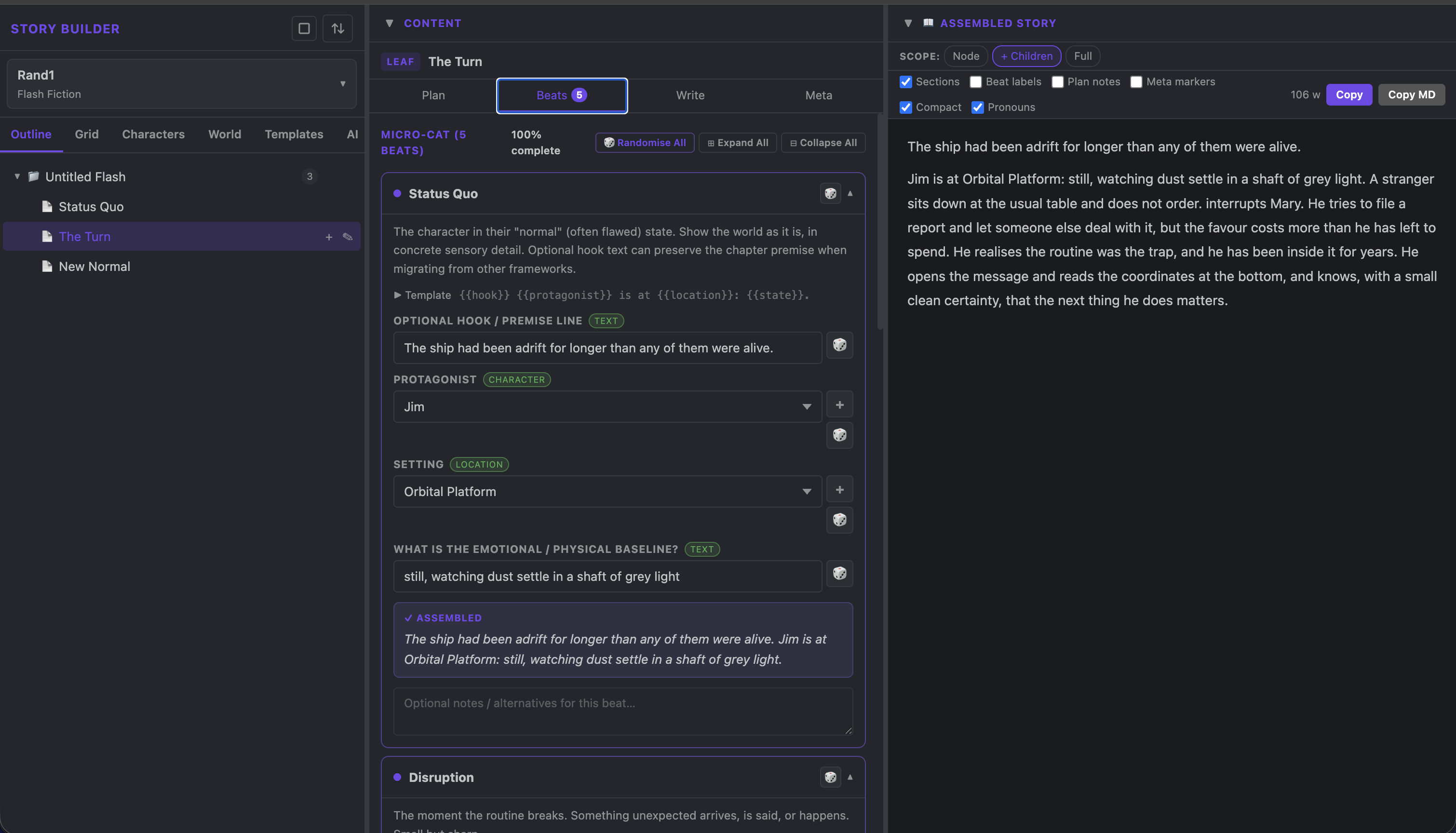
The story tree
Your project is a story tree of container and leaf nodes. Each leaf can hold free-form prose and/or a beat sheet, and container nodes hold structure. Multiple project types ship with sensible default trees: Novel, Short Story, Flash Fiction (< 1000 words), Flash Fiction 2 (< 2000 words), and Series.
Beat frameworks that nest
Beat frameworks can be applied at any node, at any scale:
- Leaf frameworks (apply to a single node):
- Micro-Cat (5-beat) — Status Quo → Disruption → Escalation → Turn → New Normal
- 3-Beat Paragraph — Physical Action → Observation / Setting → Internal Reaction
- Snowflake (guided) — Hook → Setup → Complication → Pressure / Choice → Reversal → Resolution
- Structure frameworks (generate a subtree of child leaves):
- Save the Cat (15 beats) — book-level structure
- Hero’s Journey (11 stages) — book-level structure
The same framework can scaffold a single paragraph or an entire book — which is the whole point.
Slot-based templating and the phrase pool
Every text slot in a beat framework is a {{key}} placeholder that resolves to the slot’s value
at assembly time. On top of that, every slot has a curated pool of evocative prose fragments
behind a 🎲 randomize button, so hitting “random” repeatedly hands you fresh, well-written
phrasings to nudge in your own direction.
Entity slots resolve from your project itself: {{protagonist}}, {{character}},
{{location}}, {{next_location}}. Pronoun tags ({{pronoun}}, {{him}}, {{her}},
{{his}}, …) resolve to the grammatical form matching the protagonist’s pronoun — so your
templates stay character-gender agnostic, and swapping the protagonist’s pronoun updates the
whole assembled story.
Characters, world building, and the Chapter Grid
- Character management — name, role (protagonist/antagonist/supporting/ai/other), pronoun, motivation, goal, conflict, epiphany, ghost, notes.
- World building — locations and factions.
- Chapter Grid — POV, location, plot event, subtext, and red-herring fields per node.
Assembling the story
The assembled-story output renders the whole tree into flowing prose, with toggles for
headers, beat labels, plan meta, meta markers (<!-- [META: Label] --> become styled badges),
compact beats, and pronoun substitution. Templates are validated loosely: an unrecognised
{{tag}} passes through literally rather than silently breaking your custom template.
Projects, persistence, and sharing
Multiple projects live in localStorage (with Pinia persistence), switchable from the toolbar.
Project JSON can be exported / imported for backup or sharing, and the app is fully
client-side.
Tech stack
Vue 3 (Composition API) + TypeScript, Pinia with pinia-plugin-persistedstate, markdown-it
for story rendering, md-editor-v3 for prose editing, nanoid for stable IDs, Tailwind CSS for
styling, and Vite for build. There are no tests yet (on the roadmap).
Status
An AI settings panel exists in the UI but no provider is wired in yet — so far this is a human-powered writing tool. Build-and-run-yourself for now; hosted builds / GitHub Releases are a TODO for the future. The roadmap also covers Chapter Grid enhancements and cross-project templates/phrase pools.
Code: github.com/abulka/story-builder (private for now)